Tuesday, March 10, 2020

FEATHERS, FEATHERS EVERYWHERE - It's That Time of Year Again


I don't know about you, but currently in my bird  room, I am seeing the beginnings of the bi-annual molting of some very beautiful parrot feathers.  It's a race - if I see a feather that has just floated to the bottom of the cage, I grab it up and put it in one of the many bouquets I have around the house.  (I know, interior designers would cringe at my feathered wall decor here, there, well, anywhere there is a space to place a handful of feathers!)   And then there are the feathers that land in the unenviable location that pretty much puts a bullseye on them...marked for poop. I grab those out, as well and give them a good, gentle wash and rinse, air dry, and into an established grouping they go!  If they're scraggly, chewed on, or have too much additional "material," into the trash they go.  

Over the years, I've tried a variety of things to diminish what turns into this three-dimensional wallpaper.  When we have visitors with children, there is always curiosity about the birds which then requires a tour of the bird room or outside to the flights on warm days; a quick educational journey to instill a spark of respect and possibly love and passion of these feathered beasties.  And then, who knows? possibly future, responsible parrot stewardship.   We can only hope.  After the tour, if young eyes haven't already spotted a feather on the ground or in the cage, I send everyone home with at least one feather to remind them of their encounter.  


Another option I have used is saving sets of feathers and then selling them on eBay.  I notice now that bird owners sell them on Pinterest, too.  There is  definitely a market for them, and sometimes the prices asked are fairly high, depending on  the  rarity of the birds' feathers, the colors, the size, symmetry, amount, etc. When I have been successful with this, I have chosen a parrot rescue and donated the proceeds. It's pretty much a win-win: I don't have as many feathers (as least temporarily until that next molt comes around); the feathers are used for some gifted person's crafts, or Native Americans create incredible ceremonial decorations...and the rescue has some much needed extra funding.  (This is an awesome activity for bird groups for their own fund raisers, as well.)  

One of the most rewarding paths, I believe, that we can do, regarding "recycling" our flocks' discards, is collecting those feathers and sending them directly to Native Americans for their celebrations, traditions established hundreds, if not thousands of years ago.    And if you are in the same feathered boat that I'm in, and feel really guilty at even the thought of throwing away something as beautiful as a Scarlet Macaw's 22" tail feather or an incredible multi-colored wing feather from your Amazon or Grey,  or whatever species you share space with, then you might possibly consider this option. The tribes need and so appreciate these donations, and you are making a difference for the Native Americans, as well as parrots in the wild.  

Here are links to a well-established organization, started by Steven James, Feathers for Native Americans, that collects donated parrot feathers, with information about how to donate, how feathers are used, what feathers will never be used, and your impact on the Central and South American parrot population by providing molted feathers.  Feathers for Native Americans is also involved with  saving the Blue Throated Macaws, a cause championed by the late Laney Rickman. 


Better to be used and appreciated like this than gather dust on my walls, as beautiful as they are.  And heck, I know I can create my "home decor" anytime, as long as my birds keep sharing their gorgeous bounty.  Think about it!

Saturday, February 29, 2020

HEIGHT DOMINANCE - IT'S FAKE NEWS

HEIGHT DOMINANCE - IT'S FAKE NEWS
by
LISA BOLSTAD

Time and again I see posts on Facebook from people desperate for answers to the problems they are having with companion parrots.  They assume the groups that are specifically set up for people who live with parrots would be the logical place to seek help.  After all, here are hundreds, if not thousands, of people with experience and good knowledge, right?

Sometimes not so much.

If I had a dime for every time I've seen bad advice given in a pet parrot Facebook group...well, we all know how many huge bird rooms I'd have.  One of the most common posts I see are pleas for help with a biting parrot.  Also common are requests for advice about a parrot on a shoulder who has bitten someone's face.  There seems to be an easy remedy for this - don't put the parrot on your shoulder.  However, the responses most often given concern something called "Height Dominance."  Height Dominance is the idea that when a parrot is perched higher than eye level, it becomes dominant in its own mind or has a sense of superiority. This concept should have gone obsolete along with big hair and the Berlin Wall, but some of the places where you can find this archaic information are mind-boggling. Even a few veterinary websites proclaim the dangers of allowing a parrot to perch above you, where it will immediately feel like the dictator of a third world country.

Admittedly, I don't breed parrots, I don't tour the world training parrots and I haven't spent years in other countries studying parrots in the wild. However, I read literally everything I can get my hands on - particularly about wild parrots, I attend conferences and workshops, I have long discussions with aviculturists I watch videos, and I work to find new homes for birds.   I have lived with parrots for over twenty years, both my own and fosters.   I've watched them closely, examined who motivates them, tried to understand how they see the world as a bird. I have a house full of my own reprobates who have various reasons for not doing what I want them to do...none of which have anything to do with a need for dominance.

A few friends of mine who breed parrots have noted that with a nesting pair, the male will sit higher than the female.  There are many reasons a parrot may want to perch higher than another parrot.  A male sitting higher than a nesting female doesn't speak of dominance to me, it speaks of protection.  Height provides a better view of things, a better opportunity to jump on a predator or rival.  We all know of males who kill mates.  Conversely, we also know females can, and sometimes do, attack their male partners. I completely believe a male may sit higher, but I don't think it's a show of dominance over a female.

The consensus from biologists, ornithologists, and published aviculturists who have studied parrots in the wild seems contrary to the height for dominance theory.  Parrots do have sentinels, particularly Pionus parrots, who will pick a high branch and cycle flock members through to keep watch. Parrots also squabble in the wild, but I have never read anywhere that it's over a desire to be dominant by having the highest branch.  What purpose would that even serve?  Dominance in mammals serves a purpose - first in line for a kill, making decisions for the pack, pick of the females.  For parrots, there's always another high branch, or another piece of fruit on another tree.  Dominance doesn't seem to accomplish anything here.  We know with mates there's a complicated mating ritual that involves a lot of displaying and, for parrots, mutual attraction as in most instances they will stay together for life.  I don't think any female parrot is going to pick Brad because he's a good fighter over Percival who tickles her fancy for who knows what reason.  Parrots do remind me of humans a little in this regard.  They fall in love for reasons that make no sense to an outsider.

For people who breed parrots this is a moot point - if a pair seems happy and they produce offspring, it really doesn't matter why they are perching higher.

Here's why that theory is dangerous for companion parrot owners.  Parrots are incredibly intelligent, sensitive beings.  This is why we are so drawn to them. If a person is convinced her parrot is trying to be "dominant" over her, the natural reason is to "teach" the parrot that it is not. In turn, the owner is well on her way to destroying trust and ruining a relationship with her bird.  One post I read in a Facebook group (that is supposedly geared toward education) was from a person seeking help for a "biting" parrot, a parrot who in particular bit faces while perched on a shoulder. The overwhelming response was about height dominance.  No! No! No! This is not about dominance.  This is about not being able to read body language in a bird who is either highly excited, or stressed, or any number of things.  It was also mentioned that the bird won't come off the top of his cage, or will jump on the owner.  I have a number of questions here.  Does the parrot get put back in his cage every time he steps up off his cage? Is he doing something up there that is more rewarding than stepping up to do something else?  Does he jump on his owner because he doesn't want her near his cage? Is he jumping because he thinks she will force him to do something he doesn't want to do? A wing trim may settle him down, but only because he doesn't have the option of flying onto a head anymore.  I agree it may make it easier to work on training, but it doesn't teach him anything about who is "dominant."I don't believe that this means anything in a parrot's world.  In the wild, they are just trying to survive, to stay alive one more day.  Sentinels make sense.  Dominant leaders do not.  All members must be vigilant and in this way the flock provides protection for its members.

Birds LIKE high places, such as trees, telephone wires, the top of your kitchen cabinets.  It's safe up high; you can see cool stuff when you're up high.  If your parrot is above you and he lunges at you or tries to bite you when you jab your hand into his belly, it is because you are trying to force him to come down and he'd rather stay right where he is.  He is not trying to show you he's dominant.  He isn't sitting up there thinking, "Well, Debbie, it's pretty clear from my position of height who is actually in charge here.  Maybe if I was below your shoulder, I'd step up.  But I'm not.  So, off with you, inerior being.  I have position-of-power things to do." Oh, and that whole push-your-hand-into-a-parrot's belly repeatedly, while saying, "Step up! STEP up!"? Yeah, they hate that.

I live with a large flock of parrots and I foster other birds throughout the year.  I've spent time with big, male Amazons who lunged and tried to jump on me when I got within a few feet of them.  I've had birds so frightened they slammed into their cage bars if I even walked into the room.  I've learned some important lessons, the most important being to never label a bird.  A parrot is not mean, or a hater, or (my favorite line) unadoptable. Take your time, go slowly, watch and study, and do not force a parrot to do something unless it is absolutely necessary.  They aren't trying to dominate you, they are so much more complicated than that.  If you have the patience to study them, you'll figure it out. If you want quick and easy answers, parrots are not for you.


Thursday, August 8, 2019

OUTSIDE TIME FOR YOUR FLOCK


I know that getting your birds outside can be a challenge with busy work & family schedules, but if and when you can, here are some tips for making it a great experience for your flock.

1 - What is the weather going to do? If there is a shower, do they have protection from rain? Can you get them inside in a timely manner before a storm?  And make sure there's some good shade and protection from direct, hot sunlight.  


2 - Check the water dishes in outside flights.   It evaporates quickly, and gets dirty quickly.   Clean water dishes daily and make sure water bowls are filled.


3 - Perfect time for a summer bath! - Outside in the hot shade is a great place to give your birds a spritz.   (I actually use the mist setting on my garden hose to give my birds a cool down.)  If your birds enjoy bathing in a bowl (or a hanging birdbath), the outside flight is the perfect place for a Splash Down. 

4 - Check your outdoor cage or flight and make sure that it is securely closed.  

5 - When you carry your birds into their flights, keep your eyes focused on your bird as you place him/her on the perch until you have left the aviary to make sure he doesn’t spook and try and fly out.  

6 -  Do NOT trust that, since your bird's wings are clipped, that it will not be able to fly.  Truly a parrot myth.  Hold your bird on your hand (NOT on your arm) and  firmly hold his toes with your thumb wrapped around them.  A little pressure on those tootsies as you walk outside is worth it to make sure your bird doesn’t spook at a wild bird, a noise, an airplane, etc, and then bolts.

 7 -  Make SURE that the wire enclosure is made of fencing with small, small spaces (size and strength appropriate) where your bird can NOT get its head, feet, body stuck. Yes...it happens, with catastrophic results.   This works in reverse: the small spaces guarantee that your flock doesn’t have wild flighted visitors or other unwanted guests coming into their space.

8-  Don’t put food outside for your birds.  It will only draw other critters into the space.


9 -  Give your birds some challenging toys, climbing ropes and swings to play with while they’re outdoors and take a look at them every trip outside to make sure they’re still worthy of playing with (not soaked from a rain, 1/2 gone, hanging precariously on an open quick link, etc).  Safe-safe-safe and entertaining: that’s the ticket!

10 -  Check on your birds while they are outside to make sure all is well.

11  - Keep your eyes focused totally on your bird when you pick him/her up to go inside.  Make sure the door/gate is shut behind you while you get the “death grip” on those toes...and then open the door to leave.

I know this may sounds like a bunch of needless minutia, but over the years, we’ve all heard heartbreaking stories about birds spooking and flying off or something gone awry in the flight. Owners who trusted that, “Oh, my bird won’t fly off of my shoulder/arm/head when we go outside together;”  birds that are clipped that just miraculously...fly away; birds that get caught in spaces too large for their species and are injured or worse.  

Just use common sense when you get your birds outside.  It’s good for them and you can make it the great experience that they need and deserve. 

How do your birds get outside time?   Please share in the "Comments" section below.


Monday, October 29, 2018

I AM GRATEFUL...AND THIS REALLY IS ABOUT PARROTS...REALLY!

Well, we are heading into the holiday season; Thanksgiving is just a few weeks away, and then to Christmas and Hanukkah and the New Year.   I remember when I was teaching first and second grades many years ago, my teammates and I would have a holiday feast (beef stew, corn bread, pumpkin pie, apple sauce - stew and apple sauce made by the children, corn bread and pies made by teachers and/or parent helpers) The kids made costumes, choosing to either be an Indian or a Pilgrim.   They decorated the classroom with stuffed paper bag & construction paper turkeys.  It was a pretty colorful, festive time of the year.  And it was truly a hoot to see 120 Pilgrims and Indians sitting down together, peacefully, to break bread! No arrows or blunderbusses were fired during those times.   

I always gave my little ones a writing assignment during the Thanksgiving season: I had them reflect on what they were grateful for and then they put pencil to paper.  Now...when someone only has 5-7 years under their belt, there's not much past history to reflect on, and the concept of gratefulness is tough for some, as developmentally, the whole world pretty much revolves around their own little self (and rightly so!)   So I always modeled for the class what I wanted them to do, and we would also brainstorm what 'being thankful' meant to them. There would be a class-generated list to choose from. And they would end up focusing on their parent(s), grandparents, sisters/brothers, etc, pets, favorite toys or books, etc., not having to share a bedroom, learning to ride a bike...you get the picture.  (I realize that today the thanks might focus on Nintendos or technology or maybe, for some, the health of a family member, having a place to live, etc.)   And once they had their choices made, the class went through the rest of the writing process and  Thanksgiving cards were made and decorated and taken home to share with their parents.   I hope that that activity at least opened the door of awareness and gave my students the beginning of the true appreciation of what made their lives special...even at that very young age.  For that matter, I hope that there was at least one thing special for each one of them in their lives.

I mention this part of my teaching history because I wanted to share how grateful I am now, for so many things. I don't take anything....a n y t h i n g for granted at my ripe old age.   I am truly grateful. I won't go into that long list of 'whats'  or 'whys' with you, (and it really is). This blog would be extremely lengthy if I headed down that road right now.   No,  I just want to briefly explain why I am grateful for my flock of parrots, not just at Thanksgiving, but every single day that I walk into their room in the morning and am greeted with their beauty and their spectacular vocalizations and behaviors.  And my guess is that, as parrot lovers, you feel the same way that I do. 


Friday, October 19, 2018

"STUFF" HAPPENS


Tanner has unreasonable expectations of his mom.

2018 has been a very challenging year for me, in so many ways.  One of the things that happened was having major back surgery, which included a fusion, in late July.   I had no choice...I had reached a point where I couldn’t walk at all without excruciating pain.  Successful surgery, and then I came down with pneumonia three weeks later.  Another physical ordeal that I overcame over the ensuing weeks.    

It has been almost three months since my surgery and my body is healing, but it has come with a price, and I believe it’s worth sharing with all of my friends who have parrots and other pets, for that matter. I suppose it could be called a cautionary tale.

I have five big birds.  I have friends with many more than that, and some with just one or a few. I also had two elderly dogs at the time of my surgery.   I have friends with dogs, cats,  birds, menageries!   I realize I’m not alone in this. And we all know the demands that our feathered babies and other animals  put on us on a daily basis, and we all have a routine of feeding, cleaning, enriching, playing/training.   What happens when we are physically unable to care for our flock, our animals?  This is what I faced and still do today on a much smaller scale.

I came home from the hospital after five days.   I couldn’t do ONE thing for myself.  Nothing. I was incredibly weak.  I could not take necessary healing steps without the support of a rolling walker. Balance and walk? Very scary stuff.    I couldn’t get anything to eat or drink by myself from the kitchen.  I could not move my body one iota in bed to get  into a comfortable position.  Everything required help.  Everything.   Fortunately for me, my husband was with me every single moment, there for every single need.   I was nurtured and cared for 24/7.   After a few days of being home, a dear friend of ours came and stayed with us for four days.   His presence was a godsend.   It wasn’t just to help me, but to cover the  necessary things that were going by the wayside because Robert was totally focused on my recovery.  And that  included taking care of the Thomasson flock and dogs.  

Our dear friend, Art, passionately loves parrots, and he “stepped right up,” pulling bowls, feeding/watering, twice a day.  Changing papers, cleaning cages, and entertaining my miscreant crew in the bird room.  He helped with our dogs as well.   He walked them when they needed to go out (and that was not an easy task, as our 80 lb German Shepherd mix had suffered a debilitating stroke in his spine).  He picked up, wiped down, and was totally focused on taking care of everything, including us.  And then he had to go home and we were on our own again. But those four days of his help made all the difference in the world, and we are so grateful.

So, how lucky am I?  Very lucky.  I have a loving husband who helped me through my recovery.  We had a dear friend who covered all “uncovered bases” for days. My birds did not lack for anything.  Their needs were met and more so.  My dogs’ needs were met.  My needs were all met.  (Even long conversations during the night when I couldn’t sleep, which was most of the time.).  And, I didn’t mention that we had a neighbor, who also has parrots and dogs, who came over and tended our animals while I was in the hospital while Robert stayed by my side.  

I know others who have had extreme surgeries this year. They have pets as well.  I know I was not the only one who has faced serious health issues like this.  But as I mentioned in the beginning, I was very lucky to have had support, for me, for our animals, for our household.   

What do you do if you live alone or are the sole caretaker in your household for your animals and either suffer a debilitating accident, come down with a serious illness, or need major surgery? Do you have someone you can rely on who will step up and insure that your flock, your dogs and cats and rabbits, etc, are fed and cared for?   You may want to stop and reflect on this and consider your options if something should happen to you.  Here are some
things you may want to think about and possibly act upon:

FIND SOMEONE TO HELP YOU - A friend, a neighbor, your child, your children, husband or another relative
Have a plan. Start by engaging someone to take care of your pets, now, ahead of time, before you may need help.   If it’s a friend or neighbor, and they also have pets, you can possibly set up a potential “exchange” of care, ie., “I can care for your animals and you can care for mine in case of an emergency.”
Your plan may also include the possibility of boarding your animals, or having someone take your animals temporarily into their homes.   Be creative with your options.   Whatever you do, create those options now.  Remember: STUFF HAPPENS.  

WRITE DOWN YOUR PETS’ ROUTINES - eating, exercise, medications, special needs, veterinarian’s phone number, etc
Make sure your helper knows your feeding routines and anything else necessary for your pets’ welfare.  It’s a great idea to WRITE DOWN what your daily feeding rituals entail for all animals, including meds for your pets.  Taking pictures of what the food/pills look like for a feeding may be helpful.  Keep a folder handy in the kitchen with this information.Doing a couple of run-throughs for feeding  and care with you present will help.  There is a world of difference between explaining to someone what needs to be done vs having them actually do it with you a couple of times.   I speak from experience! 

FOOD PREP - stock up
If you know you are going to be infirm for awhile, and you make special concoctions (like “chop”) for your animals, make sure your freezer, fridge, or pantry is stocked up with everything a caretaker would need, and make sure it’s easy to access.   

ADMIT WHEN YOU NEED HELP -  don’t be a hero
Your birds’ and your other animals’ lives all depend on you.  If you are incapacitated for any reason, their health, their well-being will suffer.   And that is why we read sometimes of horrible ‘rescues’ of neglected birds, dogs, cats, etc. Many times it is not because the owners didn’t love and care, but that, at some point, the owners were physically unable to give their animals the care they needed.  Be cognizant of when to ask for help...before things get out of hand. 

IT’S NOT OVER ‘TIL IT’S OVER recovery takes time, sometimes a long time, sometimes never
I am able to feed my dog, feed my birds by myself.  I’m pretty healthy right now.  But, since I’ve had back surgery, I am restricted as to how I can move...and getting down on the floor to change papers in cages and clean trays is a monumentally big deal.   I can do it, but I ask for help from my husband a lot with this to avoid  incorrectly moving my back.  It’s going to take months for my fusion to heal completely - I know that there are things I need assistance with.  If I’m careful now, and ask for help now, I will probably heal completely down the road...and the papers will get changed and trays will be cleaned.   

Accidents happen, surgery happens, illnesses happen..and, darn it, we just get old!  We can heal completely from some things, other things may impair us for life.  If that is the case, we ALL need to take a long, hard look at what we are capable of doing and what we may need to let go of, either by getting assistance or by looking at re-homing at some point in the future.  

I'm not trying to be a Debbie Downer....just trying to be extremely pragmatic and honest.   I was and am very fortunate.  I had help with me.  I had help with my animals.   If I hadn’t had all of that help, my birds and my dogs would have paid the price.  I felt that extreme helplessness for those first weeks, and was so very grateful for what my husband and Art did to make sure that I thrived, and that my animals also thrived, without me...for awhile. 

If you waded through this whole diatribe, you get a medal and I thank you.  I hope that you take this blog to heart  and consider how stuff, when it happens (and it most likely will!), will impact you, your animals, your family, and how you will be ready to respond. 

Monday, December 4, 2017

BREAK OUT THE APPLE CIDER VINEGAR

THE GUILTY CULPRIT, SANTANA- AKA "TANNER"

I've had my Scarlet Macaw, Tanner, for ten years.    He has been a joy, a hoot, an incredible addition to our family and the flock.   He does a great pirate "Aaarrrrrgggh!" when I ring one of his bells, and bows his head for long head scratches. The list is long with what makes him so special.  But...with an "up" side there may be a "down" side, and with Tanner, this is the case.   

When I adopted Tanner, he may have been exposed to a strain of Clostridium (http://www.avianbiotech.com/diseases/clostridium.htm).  For years, I have dealt with some rather disgusting, stinky droppings from this big guy.  (I would share pictures here, but I'll spare you.)  Tanner gets regular checkups with Dr. Jerry LaBonde (Homestead Animal Hospital, Centennial CO) and this has been a front-burner issue the entire time I have had him.  We monitor his weight, his health, his behavior, and though his droppings are not normal, everything else about this bird is spot-on great.  

Early on, Tanner took antibiotics for his condition, and as I recall, they worked very well on a short-term basis, and once the prescription was finished, the Clostridium would return.   I stopped the drugs as it really didn't resolve the issue and began years of cleaning up his cage and the floor and the nearby wall ... because the droppings didn't stay in  his cage.   It was just the way it was and the way it was going to be.  Ok by me...I really love him.

A few weeks ago, Get Creative2 hosted Charise Mixa and Lisa Bolstad for a workshop in Parker, CO on sprouting for parrots.   One of the topics that came up was the holistic benefits of  apple cider vinegar and adding it to our birds' water bowls.    It dawned on me that I had actually tried the ACV with Tanner years ago to attempt to help his tummy issues.  I honestly can't say why I stopped using it, but I did.   However, I was inspired by the suggestion by Lisa to give ACV another try to see if it would help Tanner's stomach.

Home I went, stopping at the store for ACV on the way.   I started immediately - 1 tsp to his large bowl of water per day. * And...(drum roll,  please, along with a "Knock on wood..."): the next morning there were normal, big ol' macaw droppings straight down in the bottom of his cage.  Solid, well-shaped, all  3 parts present.   What a surprise! I thought it might be a fluke, but for these past two weeks, with the daily tsp of ACV in Tanner's water, his droppings continue to be  n-o-r-m-a-l.   

I don't know if he feels any better, because his demeanor, his overt behaviors have never indicated anything out of the ordinary with his health, but I feel better for him.  I will continue with this daily dosage, along with his regular wellness exams with Dr. LaBonde and hope that the apple cider vinegar continues to keep the health of his stomach in balance.

I started to do some more research online about the health benefits of apple cider vinegar so that I could personally write an entire blog about it, but I came upon an excellent, excellent piece written by Alicia McWatters, Ph.D., C.N.C.    I knew I couldn't do it better than she did, be more thorough.  So, I highly recommend that you follow this link: http://www.quakerparrots.com/forum/index.php?showtopic=58876 and read about the history of vinegar, why it is beneficial to our birds, to us, how it is made, how to use it, even misting sprouts with ACV!  It was a very worthwhile read for me...and I hope it will be for you, as well.

And last, I am not recommending that you rush out and buy some organic ACV and give it to your bird(s).   I am  recommending that, if your bird is experiencing some gastronomical issues, or you think he may benefit from a dose of ACV, please ask your avian vet first, let him/her give you a daily dosage amount, and then proceed.      Good luck!

* Update (12.5.17): I spoke with Dr. LaBonde today and he gave me a specific ratio of apple cider vinegar to water to give to our birds: 1 Tablespoon acv:1 Liter water or 1-1.5 teaspoon acv:1 Pint water.  Dr. LaBonde shared with me that a larger dose (as in the 1 tsp. per water dish) that I was giving to my macaw was too much, but only in that it would make the water less appealing for my bird and he might drink less than needed.  There was no harm in the amount...it was just that it affected the taste.  So I will mix up a pint of water and vinegar, put it in the fridge and use it specifically for Tanner, and not have to get out my measuring spoons every morning!   If you're going to try acv, this is the formula you need to use.   

Saturday, November 4, 2017

CLICK? SURE! TEACH AN OLD BIRD NEW TRICKS!

Mercedes Bijou Basin Surprise ("Sadie")
Many years ago, my husband and I came across a "dump dog" about 10 miles from our home as we were taking a Saturday afternoon drive. According to local ranchers, she had been sitting the entire day in the same spot by the side of the road, probably waiting for her owners to return. We tried to locate the owner of this pup for hours to no avail, and so we brought her home with us and tried to find an Australian Shepherd rescue. At the time, there were no Aussie rescues in Colorado and so....she was ours. Our love for Sadie has lasted almost 14 years.  Being an Aussie, her incredible intelligence was evident and her ability to learn new skills was amazing.   I immediately enrolled her in obedience classes and ended up taking her through advanced obedience and advanced agility.   One training method that worked amazingly well with Sadie was clicker training.   I could (and still can) teach her something new in just a few minutes.  And even though her sight and hearing are now failing, she still responds enthusiastically to the commands that she learned those many years ago. 

Clicker training.  It worked so well with my dogs.  But I could never coordinate my hands when I was trying to work with my feathered flock.  I decided I needed three hands: one to hold the target (the "bridge"), one to hold the reward, and one to hold the clicker!   I have to admit, as good as I was training my dogs with a clicker,  I gave myself an "F" for my efforts with my birds.   Until....

Two Saturdays ago I assisted with Barbara Heidenreich's Fear Free Animal Training workshop that she presented to the Minnesota Companion Bird Association.   At the presentation, she had available a handy little "tool" that she had invented (telescoping target stick with clicker)...and when I saw it, I knew I had to have one.  (And ohhhh, how I wish I had invented it!)  Here is Barbara showing how it works:

  There are so many reasons to train our birds using positive reinforcement.   Not to do "tricks," per say,  but to make them comfortable accomplishing actions that make their lives, our lives, and our long-term relationships enjoyable, with as little fear and stress as possible, ensuring our birds' comfort and safety.    Think of it: easily getting your bird to step up; staying in a stationary spot in the cage so you can change papers without their "help;" loading and unloading into a carrier for traveling; stepping onto a scale for a daily weigh-in; coming out of a crate at the vet's office.   The possibilities are endless.   Using clicker training is a great, positive method to utilize with parrots. 

I am inspired to spend more time with my birds working with my new FFAT clicker/target. I've just begun this clicker training journey anew with my flock, and I am not an expert trainer by any means, but I am determined to use this excellent tool, (THAT ONLY REQUIRES TWO HANDS!),  and try to guide my birds toward some great, positive behaviors.  Maybe I can get a video or two of my progress on a blog in the near future.

Yes, you can teach old dogs....and old birds new tricks!  Click!

Have you used clicker training with your birds? Have you had success? Please share your experiences in the comment section below.
 

Monday, October 30, 2017

PUMPKINS...THEY'RE NOT JUST FOR CARVING ANYMORE

As many of you may know, at times, my thumbs can be fairly green.   The 2017 gardening season was no different, and this Spring I couldn't wait to get my pumpkin seeds into the ground.   Planting pumpkins is a double-edged sword endeavor: First, if you're lucky enough to have them take off, avoid hail, early frost, critters, you end up with a healthy crop of orange beauties.  The down side to growing pumpkins is that, IF they do take off...that's literally what they do; they take off and take over the entire growing space, creating a canope of giant leaves over other crops.  You have to hope that everything underneath is either ready for harvesting, or can stand quite a bit of shade.  I just didn't care about that.  I ... wanted ... pumpkins!


Last year I was not very lucky.  My pumpkin hill (unwisely planted outside  of the mail gardens to avoid aforementioned downside) never got off of the ground.  Voles, moles, gophers and seven-banded ground squirrels annihilated the baby roots.  It was pitiful.  Really pitiful.   I succumbed to failure but faced 2017 with pumpkin determination.

This year I headed back into the main garden and wished the surrounding vegetable crop "Good luck!"   I wanted pumpkins.  Heirloom pumpkins.   Big pumpkins.   Pumpkins not for carving or catapulting, but to bake and then put to so many wonderful, healthy uses.  And I got    lucky.

The bed on the left was "Rouge vif D' Estampe" and the one on the right was "Musquee De Province."  For you gardening buffs, here's a description of the two pumpkins:

" Rouge vif D' Estampe" - A very old French Heirloom, this was the most common pumpkin in the Central Market in Paris back in the 1880's. (Baker Creek Heirloom Seeds)

"Musquee de Province" -  The skin is a beautiful, rich brown color when ripe. The flesh is deep orange, thick and very fine flavored, fruit grow to 20 lbs. each. This is a traditional variety from southern France. Pure European seeds. (Baker Creek Heirloom Seeds)

Pumpkin blossoms showed up over 20 feet away from their home base.   And once pumpkins started growing on the vines, it was "Katie, bar the door!"  There was no stopping them.  Harvesting other vegetables became a precarious game of  tip-toe hop scotch, trying to avoid the hearty but delicate pumpkin vines and not instantly giving those babies a death sentence.   I truly had no idea what my yield was going to be because I just couldn't get around all of the vines to peak! Until....the pumpkins became so big and so obvious, there was no denying the behemoths were there.  Nirvana. 


I harvested my pumpkin crop at the beginning of this month.   Not hundreds and hundreds of pumpkins like you see in the fields near Pueblo and La Junta, but a gratifying abundance for a small-time gardener.  (Can you seen the green flesh on the smaller one in the back? - Masquee! Do you see the color differentiation of the skin between all of them?)  There was a good split between Rouge and Marquee. And all month, I have taken some time to bake a few to puree and freeze for future use and also have given quite a few to friends. One of the larger ones weighed in at 28 pounds.  That's an incredible amount of  delicious pumpkin flesh.

So why a blog about pumpkins...this is supposed to be about parrots?!  Well, it is about parrots, (and us as well).  Pumpkin is so good for us, and for our birds.  Here's the process I'm going through with my orange beauties and how I plan on using them and how you can, too.

1 - Buy (or grow) an heirloom pumpkin - one good-sized one will do you!  (I've seen the Rouge pumpkins with all of the Halloween pumpkins at some stores).  Yes, it will cost more...but the quantity and quality of pumpkin flesh that you reap will be well worth it.

2 - Before you bake it, be sure to rinse and dry it, then cut it into chunks and scrape the seeds and pulp from the flesh on each piece.  Set the pulp and seeds aside.   Those seeds are important: Save the seeds for seasoning and roasting,  for your parrots for treats, to sprout, and TO GROW MORE PUMPKINS OF YOUR OWN NEXT YEAR!  

3 -  Here's some easy instructions for baking:
  https://www.livestrong.com/article/443307-how-to-bake-a-pumpkin-in-the-oven/
(I don't use the oil - as I will be giving some to my birds.  And...I'm lazy and don't use the water, either.   Skin side down on the baking sheet, nothing sticks.   Everything cooks fine. Just pure pumpkin.  There is lots of moisture in the pumpkin.


Musquee de Province Pumpkin seeds drying
Rack of Rouge Vif d' Estampe beneath on second rack
4 - While your pumpkin bakes, separate all of those seeds from the pulp and spread on a piece of parchment paper or drying rack.  Compost the pulp...or let your birds nibble on a bite.  Leave the seeds alone for days...until they are completely dry.  If you bag them too soon, they will have some pulp on them, they may be moist, and you will end up with bad seeds.  Dry. Dry. Dry.   Bag and label them when completely dry.
5 - When you remove your pumpkin from the oven, let it cool completely, and then scrape  all of the flesh from the skin.   Put the flesh into your food processor and puree.   Scoop up 2 cups at a time and save in air tight storage containers in your freezer. (two cups because it's a pretty universal amount of pumpkin puree for recipes)

As you are processing your pumpkin, you MUST do taste tests.   Pumpkin is delicious...it's even more delicious because it's not coming out of a can.   Share small bites with your birds. They will love it! And of course, have another bite yourself.  And another.  Mix a little pureed pumpkin into your bird's chop in the morning.  (Give a bite or two to your dogs - it's great for digestion.)  Bake it into your bird's grain mix or muffins.   Lots of healthy possibilities for your critters and you can't go wrong. 

So...that's it: nutritious additions to our birds' diets, and of course the endless options of nutritious and/or decadent recipes for human consumption: pies, soups, breads, muffins, scones...oh, my!

Remember: pumpkins are not just for carving at this time of year.  Take advantage of the plethora of varieties at your grocery store, take some time and bake one up, and I promise you won't be disappointed with the results.  It's much more creative, IMHO, than carving a face on a beautiful fruit (yes, fruit!) and just pitching the best part in the garbage.

Even though I am now inundated with pumpkins and processing them, I'm already planning on the garden planting schematic for next Spring. Hmmmm, where to plant the pumpkins... Can you ever have too many pumpkins?

Gotta go...the timer just rang on my stove. 


Friday, August 25, 2017

"ARE YOUR BIRDS ALWAYS THIS LOUD?"

If you have parrots in your home,  you have probably had guests who ask about your birds, "Are they always this loud?"   Ahhhh.   You can spot a parrot owner from a non-parrot owner a mile away. 😉  I never ask that question when I visit homes of fellow parrot owners.   In my humble opinion, the cacophony is just an expected bonus. But I understand.  I do.

I was standing in the kitchen this morning preparing breakfast for my flock and I found myself smiling, really, just grinning, as I worked.  I'd only brought one macaw out to keep me company while I washed bowls, refilled fresh water and prepped food, and the rest of my birds were doing their morning vocalizations before their food hit their cages.   It was amazing...and extremely loud.


My Yellow Nape went through his entire repertoire of aria arpeggios, children's songs, and chatty repartee, over and over and over again. (I have tried to record him but he is at his best when it's just the birds in the bird room. If I walk in and want  him to do an encore, he looks at me as if I'm truly intruding on a very private performance. Crickets. )


My other macaws were squawking at the tops of their lungs, and actually, I think my DYH was the only relatively calm one in the bunch...this time.


The B&G with me in the kitchen spent her time barking, squawking, and jiving to the noises of her flock. The sound was deafening.  It. Was. Wonderful.
And then my husband came into the kitchen.    He recently got a new pair of hearing aids, looked at me in slack-jawed amazement, uttered, "I need to turn the volume down on my ears!" turned on his heels, and he was gone, momentarily. Funny...the birds have been this noisy for umpteen years and now he hears them in their full glory.   Don't get me wrong: Robert loves the birds and everything they bring to our family, but there was a "volume reality check" when he traded the old pair of aids out for these high-tech new ones.

There are lessons here that we all need to be cognizant of:

1. If you are considering getting a parrot as a pet, know that they will be noisy, very noisy.  Not all of the time, but when they are...they make up for any quiet/down time.

2. Size does not matter when it comes to parrots' decibel level production.   Smaller birds can make incredibly piercing sounds. Cockatoos can vocalize loud enough to split your ear drums.  And ANY bird, near your ear, can wreak havoc and damage your hearing.

3. Don't yawn near your birds while they are loudly vocalizing.  I am not a doctor (and I don't play one on tv), and I don't know the medical reasons for this, but it seems that the ear canal changes and makes the sounds that are close very piercing and painful, especially bird squawks. When my macaws have "yelled" near my ears and I've been in the middle of a yawn, those were memorable occasions... and not in a good way.

4. Be courteous and cognizant of your visiting family and guests.   Not everyone loves parrots like we do. (SHOCK!) I have a close friend who is very sensitive to loud noises and she's really not a fan of parrots, but she is a good friend, has auditory issues, and she brings ear plugs with her when she visits.  When we get together here, we go to a part of the house away from the birds or, if it's a nice day, the birds are outside in their flights.

Consider these three options when you have visitors who may not be comfortable with your birds:

- Don't relegate your birds to a less than adequate location in your home (YOUR BIRDS are your family members, too!) , but consider  moving them temporarily to another room, with a closed door. (Think lighting, proper heat,  proper cage, enrichment, water/food, etc. in that room.) Or...
-Entertain your friends away from the place where your birds are  normally located.
-Have ear plugs available for visitors.  They work, and it's a considerate, inexpensive, and viable option.

I wish that I had a recording to share in this blog of my birds' vocalizations, but I don't. if you have your own flock, take a moment when your birds get insanely noisy, stand amongst them, and revel in their joyous jungle sounds. It's what they do and just one of the reasons we love them so much.

And THAT is why they call us "those crazy parrot people."


Wednesday, August 9, 2017

KNOWING WHEN ENOUGH IS ENOUGH


A good friend shared the following excellent article by Dr. Karen Becker with me a few days ago.   I highly recommend that you read it:

One of my upcoming  Get Creative2 Avian Workshops,"Step Up to Parrothood" at
www.getcreative2.com,  addresses just this - some of the vital thought processes that must go into getting a parrot, large OR small, as a pet.  It cannot be overstated the importance of having basic avian knowledge under your belt before embarking on this wonderful adventure of avian companionship.

After giving this article and the contents of the "Step Up to Parrothood" workshop a great deal of thought, it solidified my belief that bringing a parrot into your home involves a great deal more mental gymnastics. It's not enough to just consider the beginning processes of doing everything as best we can to ensure long-lasting good mental and physical health.  We have to look way down the road.  Let me explain.

My flock consists of five large parrots and two lovebirds.   Over the years I have been oh, so tempted to bring another bird (or birds!)  into our home to amplify the existing cacophony.  Who can resist?  With volunteering in the parrot rescue business for many years, there have been so many birds that  have tugged at my heart strings.  And I have passed on some of the most incredible birds I've ever met.  It has been challenging, but I have forced my heart to step aside for some sound reason and logic. 

Enough is enough.   I know what my limits are with the flock numbers.  I know the space that I have available.  I know the amount of time that I have to give to them.  I know that with the size of my flock being static, everyone is going to get consistent attention, love, enrichment, nutrition, etc. I know what I can physically do for them.  I know where "parrots" fit into the monthly budget (and believe me, that's a huge chunk of change!). I remain as passionate about my birds as I did 27 years ago when we brought our first (and now oldest) Amazon into our home.   

That's just me.   I have a friend who has over twenty parrots in her home and she treats each one as if it's an only child. They are all social and spoiled rotten.   She works 40+ hours a week solely to support her parrot habit;  to make sure they have the best food, toys, cages, everything.  She constantly reads of new avian research, always looking to make her flock's lives better.  That's her. And I applaud her for it.   She lives for her birds...and has created a life-style that accommodates that dedication.  She knows her own personal limits and handles them well.

My commitment to my birds is for as long as I am capable of giving all of them 100% of what they need.    I will soon be entering what our society considers "old age."  It is necessary for me to say, "Enough is enough," because I realize that, as I get older, caring for my animals, furred and feathered, will become more challenging.  To bring more birds into our home would be foolish and unfair at this juncture in our lives, for so many reasons.  And so this will remain a five big bird, two small bird home until I can no longer do, not just a good job, but a great job of caring for all of them. And when the time comes when I cannot be that "best" caretaker for my flock, I will meticulously make appropriate arrangements for them to move on ... to the next phases of their lives, as we will in our own old age.

Enough is enough. There are people who desperately love parrots.  They start out with one bird with good intentions, it turns to two, and then it becomes a newspaper headline of hoarding.    Or, parrot owners become too old, mentally or physically disabled to tend their birds. Too many, too hard. Again,  dire situations where many times rescue is necessary.  Some people are totally capable of bringing more birds into their care, some are not; and we all need to know when to say, "No, that's it for me." 

Knowing when to stop with what you have and do the best you can do until you are unable to continue necessitates a reality check.  As parrot owners and considering their longevity, we owe the birds in our care that commitment. Yes, it's wonderful and fun when birds are young, when we are young...but the clock ticks, and making good avian decisions at the right times in our lives, and in their lives, is probably one of the wisest steps we can take as we walk this wonderful feathered journey.


Monday, July 24, 2017

SAFELY CLEANING YOUR OVEN WHEN YOU HAVE PARROTS - THE VERDICT IS IN


About a week-and-a-half ago I posted a picture on the GC2 Facebook page with a link to a oven cleaning method that seemed easy, economical, and safe for parrots.  And, as I haven't cleaned my oven for years (because of choosing not to use the self-cleaning function) it was looooong overdue for a makeover.

The ingredients & instructions are simple:

1 - Take the peels from two-three oranges immersed in white vinegar in a mason jar.
2 - Let the jar set for 5-6 days.
3 - Shake the jar to insure everything is mixed well.
4 - Place in a spray bottle.
5 - Sprinkle baking soda in your oven.
6 - Spray the vinegar/citrus mixture onto the baking soda & watch it sizzle.
7 - Proceed to wipe the grime and grease from your oven. Voila! Clean oven!

Ok.  The short video made it look like a piece of cake, effortless.   Remember that motto: "If it looks too good to be true, it probably is too good to be true?"   Well, hang on....here's what I did and here's what I discovered:  


I let the jar stand a few days longer than the instructions suggested, but I figured that the citrus would just infuse the vinegar only moreover time.   No worries there.  I bought a cheap plastic spray bottle and grabbed a sponge with a safe scrub backing.   My husband removed the heating element from the stove (quite the undertaking to re-install it...really, and that's another story) and I was ready to begin. Here's what it looked like before I started. (Please don't judge me...I know how gross it is!) 
And then I started.  It wasn't as purdy and fast as the HomeTalk video, but I was determined. 


I wiped off the first application to see what my progress was.  I was pleasantly surprised - I saw the original floor of the oven.   So, more soda, more spray, and a lot more elbow grease.
I noticed a couple of things as I worked.  First, it's a messy process and so I placed some paper towels along the front edge of the oven to catch the soda/vinegar/gunk mixture as it made its way over the bottom lip of the oven.  Some of it still ended up dripping into the pots and pans drawer below.  How? I have noooo idea, but it did.   Second, I didn't realize how being a contortionist might come in handy to manually clean an oven.  Trust me: there were places I definitely left un-scrubbed    just because I could not finagle my way around    the space.   I am not a contortionist.


I continued applying and wiping, re-applying, wiping until I was done with the base of the oven and somewhat the sides, as well as the cover of the fan in the back.   The best news is that there were NO fumes, no smell really of any kind. There was NOTHING to harm my birds. Possibly the soda neutralized any odor that might have popped up?   And one more observation: baking soda has a shelf life.   I am 100% positive that the baking soda that I used had seen better "active" days...but it's what I had in my pantry and I was on a mission.   Possibly using fresher baking soda would have made the combination of soda, vinegar and citrus more effective, and the job easier.

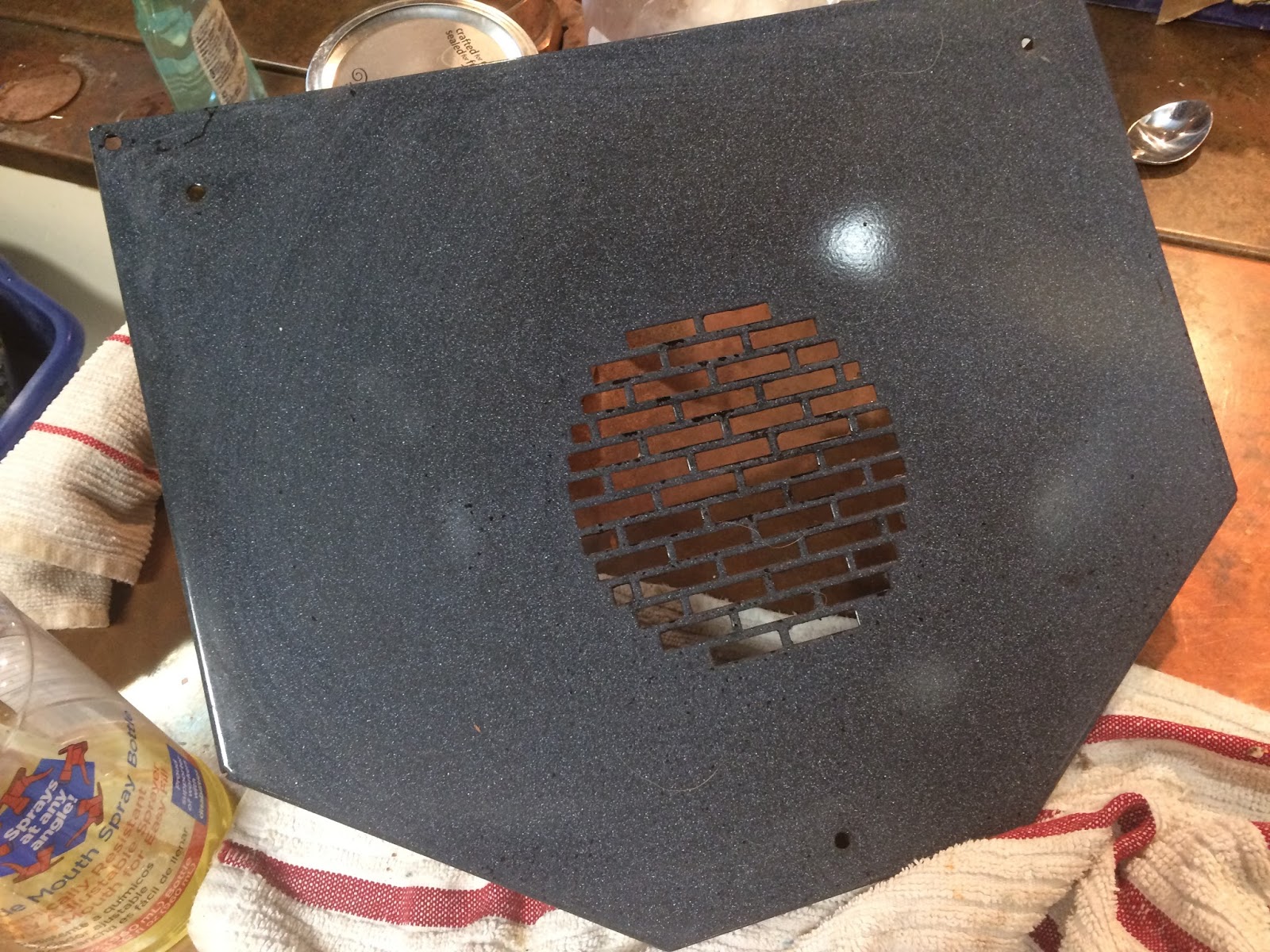
This is the fan cover that was on the back of the oven.  It was removed and I cleaned it while on the countertop.    In the first picture, the left side is the "after" and the right side is the "before," sprayed and ready to be swiped clean.   Second picture is the completely cleaned cover.   And I have to add, this part of the oven was e-a-s-y.
Fan cover - 1/2 cleaned
Fan cover - fully cleaned
It probably took over an hour to finish up, and then I had the unexpected task of cleaning all of the pots and pans, muffin pans, etc that were below in the drawer.   And then...the joy of pulling out the stove to re-install the heating element, discovering other unmentionables that needed vacuuming and scrubbing behind the stove...and it was done.  

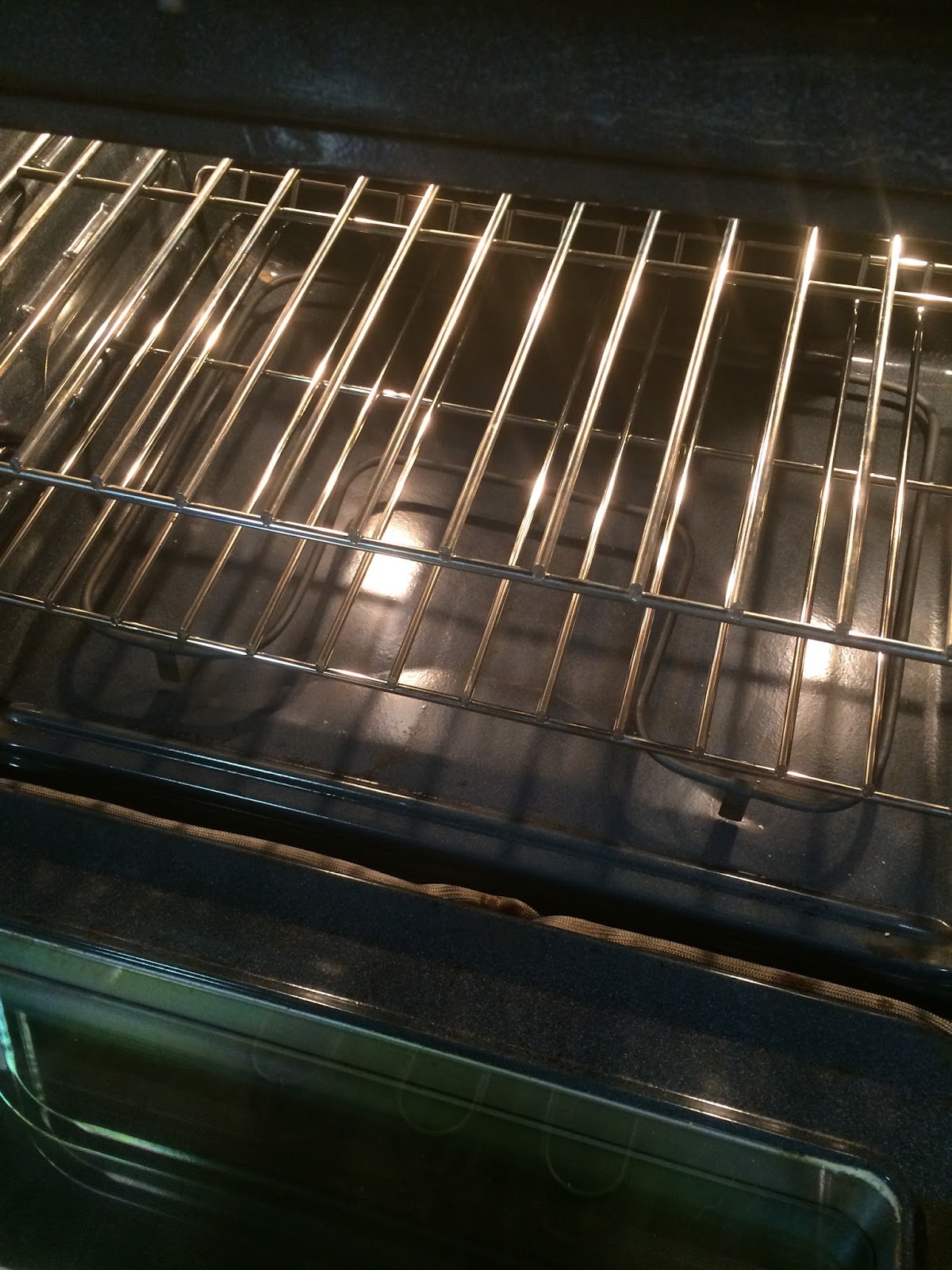
Here is what it looks like now...temporarily...until I start baking and roasting and making messes again!  My verdict: this is a great, inexpensive way, though semi-labor intensive, to safely clean an oven in a home where parrots live. (I have to admit that I broke a pretty good sweat during the process.)

I believe that if you stay up with it your oven mess, maybe do difficult sections one at a time until the entire oven is at a standard you are happy with, then periodic cleaning won't be traumatically, physically difficult at all.  I give this HomeTalk's video and method an A-...the minus is just because I had to do my share of the labor to get the baking soda, vinegar and orange peels to do their jobs....it didn't just magically dissolve away the grime. 😏

Please, give this a try and respond in the Comment section regarding how it worked for you.    I think you will be pleasantly surprised.