Monday, July 24, 2017

SAFELY CLEANING YOUR OVEN WHEN YOU HAVE PARROTS - THE VERDICT IS IN


About a week-and-a-half ago I posted a picture on the GC2 Facebook page with a link to a oven cleaning method that seemed easy, economical, and safe for parrots.  And, as I haven't cleaned my oven for years (because of choosing not to use the self-cleaning function) it was looooong overdue for a makeover.

The ingredients & instructions are simple:

1 - Take the peels from two-three oranges immersed in white vinegar in a mason jar.
2 - Let the jar set for 5-6 days.
3 - Shake the jar to insure everything is mixed well.
4 - Place in a spray bottle.
5 - Sprinkle baking soda in your oven.
6 - Spray the vinegar/citrus mixture onto the baking soda & watch it sizzle.
7 - Proceed to wipe the grime and grease from your oven. Voila! Clean oven!

Ok.  The short video made it look like a piece of cake, effortless.   Remember that motto: "If it looks too good to be true, it probably is too good to be true?"   Well, hang on....here's what I did and here's what I discovered:  


I let the jar stand a few days longer than the instructions suggested, but I figured that the citrus would just infuse the vinegar only moreover time.   No worries there.  I bought a cheap plastic spray bottle and grabbed a sponge with a safe scrub backing.   My husband removed the heating element from the stove (quite the undertaking to re-install it...really, and that's another story) and I was ready to begin. Here's what it looked like before I started. (Please don't judge me...I know how gross it is!) 
And then I started.  It wasn't as purdy and fast as the HomeTalk video, but I was determined. 


I wiped off the first application to see what my progress was.  I was pleasantly surprised - I saw the original floor of the oven.   So, more soda, more spray, and a lot more elbow grease.
I noticed a couple of things as I worked.  First, it's a messy process and so I placed some paper towels along the front edge of the oven to catch the soda/vinegar/gunk mixture as it made its way over the bottom lip of the oven.  Some of it still ended up dripping into the pots and pans drawer below.  How? I have noooo idea, but it did.   Second, I didn't realize how being a contortionist might come in handy to manually clean an oven.  Trust me: there were places I definitely left un-scrubbed    just because I could not finagle my way around    the space.   I am not a contortionist.


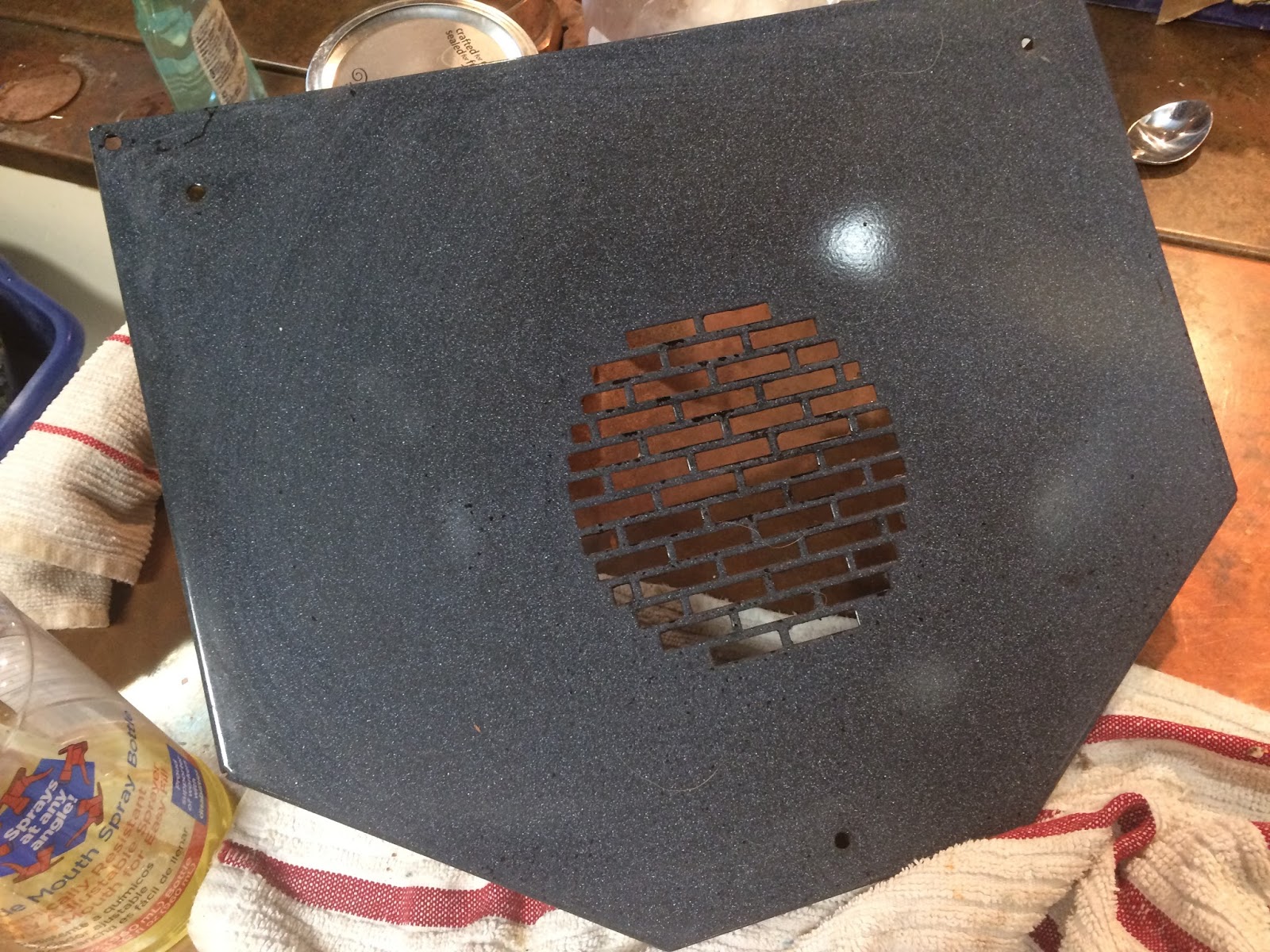
I continued applying and wiping, re-applying, wiping until I was done with the base of the oven and somewhat the sides, as well as the cover of the fan in the back.   The best news is that there were NO fumes, no smell really of any kind. There was NOTHING to harm my birds. Possibly the soda neutralized any odor that might have popped up?   And one more observation: baking soda has a shelf life.   I am 100% positive that the baking soda that I used had seen better "active" days...but it's what I had in my pantry and I was on a mission.   Possibly using fresher baking soda would have made the combination of soda, vinegar and citrus more effective, and the job easier.

This is the fan cover that was on the back of the oven.  It was removed and I cleaned it while on the countertop.    In the first picture, the left side is the "after" and the right side is the "before," sprayed and ready to be swiped clean.   Second picture is the completely cleaned cover.   And I have to add, this part of the oven was e-a-s-y.
Fan cover - 1/2 cleaned
Fan cover - fully cleaned
It probably took over an hour to finish up, and then I had the unexpected task of cleaning all of the pots and pans, muffin pans, etc that were below in the drawer.   And then...the joy of pulling out the stove to re-install the heating element, discovering other unmentionables that needed vacuuming and scrubbing behind the stove...and it was done.  

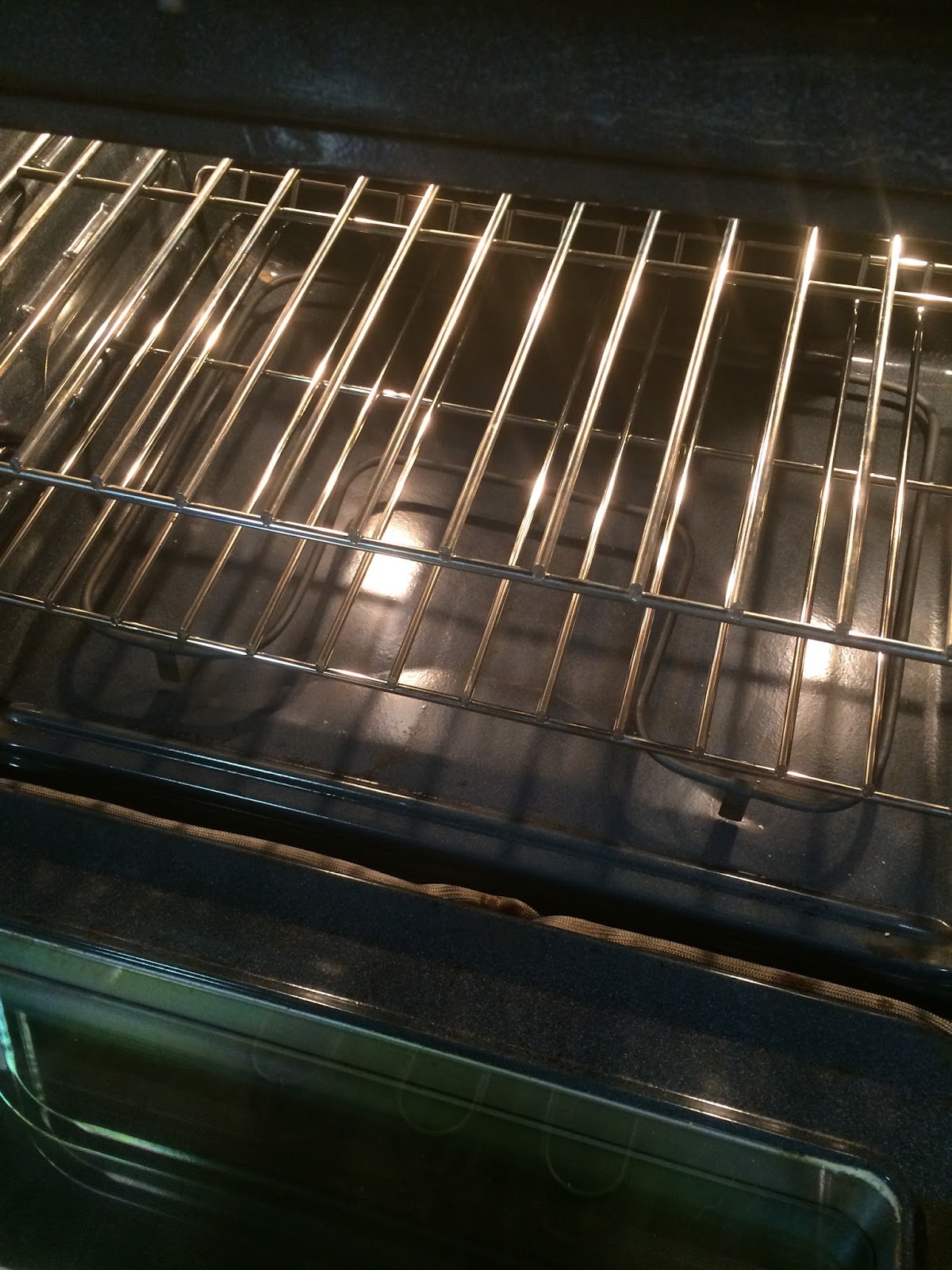
Here is what it looks like now...temporarily...until I start baking and roasting and making messes again!  My verdict: this is a great, inexpensive way, though semi-labor intensive, to safely clean an oven in a home where parrots live. (I have to admit that I broke a pretty good sweat during the process.)

I believe that if you stay up with it your oven mess, maybe do difficult sections one at a time until the entire oven is at a standard you are happy with, then periodic cleaning won't be traumatically, physically difficult at all.  I give this HomeTalk's video and method an A-...the minus is just because I had to do my share of the labor to get the baking soda, vinegar and orange peels to do their jobs....it didn't just magically dissolve away the grime. 😏

Please, give this a try and respond in the Comment section regarding how it worked for you.    I think you will be pleasantly surprised.


Friday, May 19, 2017

WHEN YOU GOTTA GO...YOU GOTTA GO!


I would like to think that I could train my flock to use the toilet like this fabulous Grey, but...reality check...it's just not going to happen in my lifetime.   Like many of you, I am content or resigned as the case may be to collect soiled papers and a day's worth of toy carnage, and then provide my flock with clean cages and fresh papers on a daily basis.  It's a routine that I'm committed to.  Not my favorite thing to do, but it's part of the big Companion Parrot Picture.

However,  I have to admit that my birds do not have the courtesy to keep their messes within the confines of their cages.    Nut shells get thrown (and then stepped on with bare feet),  food gets thrown and then cleaned up by the canine family members, and droppings sometimes just miss the mark.  It's just how it is.  And, a long time ago I took off all of the aprons around my cages due to space limitations..(I never thought they worked that well, anyway - THEY get dirty, too!). 

I have a few observations about this and I thought I would share them:

1  What are your cages sitting on? If they are located on a carpeted area of your home, you are in for a constant cycle of cleaning up the spots, whether from the flinging of food or the "other."   There are easy alternatives to this to make your life easier.    

A   If you need to leave the cage(s) on carpet, consider buying a few yards of clear plastic carpet runner.    Place it under the cage, extending out where your bird(s) share their mess.   It's much  easier to clean than carpet with just a quick spray of safe cleaner and a rag.
B   Move your cage to an area that has a tiled floor. Again, the mess is very easy to clean up.
C   Buy a remnant of linoleum and place it under the cage area.  Inexpensive fix.

2  Are the aprons on your cages?   If you have the aprons attached to your cages and continue to wipe them down, consider placing sheets of newspaper around them.  Just fold the paper in half and lay it over the entire exposed area with the other half falling over the outside edge.    These can be changed when cage papers are changed.   No muss..no fuss. 

3  Resolve the issue from inside the cage.   No matter what your cages are sitting on, you can minimize the projectile droppings from hitting the nearby wall or spraying onto the floor.   Some of our birds are just messier than others, especially one of mine who-shall-remain-nameless.  He's big, he's red, and on a daily basis he does his best to leave his mark on everything except the newsprint at the bottom of his cage.   Most of this issue has been resolved by hanging a piece of heavy plexiglass to the side of his cage which blocks the path of his droppings.  We drilled two holes in the top of the plexiglass and then attached it to the inside of the cage with clevis pins.  You could also use zip ties to hold it on.  If you have lorikeets, you might consider a thin sheet of plexiglass attached to the nearby wall, to save on vertical clean-up!   
      
4   Do your bottom trays get caught in the crossfire as well?  If they do, and your cage design allows it, just fold a sheet of newspaper in 1/2 and slide it under the bottom grate, and over  the bottom tray with the edge extended to cover the lip of the tray.  It keeps the bottom tray clean and just replace it when you change all of the papers.

So, those are my ideas for solutions that have worked for me.  Literally potty-trained?    Not even close.  But the situation is manageable and not too time consuming.    What works for you and your birds?  Please share in the comment section below.   

And, if you like this blog and it was helpful, please share it with your parrot friends on Facebook! Thanks!        


Wednesday, April 26, 2017

RESPONSIBILITY DECENCY HUMANITY


Duke - deceased - April, 2017 - Lions Gate Animal Sanctuary
Agate, Colorado


I live in Elbert County, Colorado.   If you also live in Colorado you may have seen or heard the news story recently about lions, tigers and bears being euthanized because the owners of their sanctuary recently lost their 'case' before our board of county commissioners to move to another piece of property within the county.   I won't go into the details, but  there is a link to the story below if you'd care to read it.

I won't take sides on this issue in this blog.  I certainly don't know all of the details yet, either.  I know some of the people involved, and I definitely know how our local county commissioners conduct business. There were no surprises with this decision.  But it really stopped me dead in my tracks and made me think about our parrots and the situations that many birds find themselves in, due to the consequences of our actions or lack of actions.  

There are parrot rescues and sanctuaries across our country.  They are full to the brim. There are waiting lists.  Some do a fantastic job with the resources they have; others are "getting by" at best.   There are also well-intentioned private citizens who take unwanted birds into their homes, and many times these situations get out of hand...and you eventually read about them in the newspaper: people who take in a few, those few turn into 10, 20, 50 or more and then conditions deteriorate, animals suffer, and the birds are confiscated to be dispersed to other 'rescues' as best as possible, some euthanized. It's a frantic scramble...it always is.   And it's not pretty.  I can attest to that.

What happened in Elbert County with the cats and bears is horrific.   There were at least 11 animals that were destroyed. But what happens when a huge parrot rescue goes under for whatever reason, or there is a large hoarding situation uncovered?  Possibly hundreds, thousands of birds are immediately in need of shelter, cages, nutrition, veterinarian care.  The logistics are overwhelming.   How will all of that happen? Parrots (and ALL animals we have domesticated or caged) deserve the same attention and care that those huge wild animals did at Lions Gate. Yes, much smaller species, but in need of and deserving of the same humane, compassionate care.  It's a monumental task.  It's happened.  And it will happen again.   

What can we do? It starts in your home, in your own life...if we're talking parrots.   First, don't get a parrot  unless you have spent a great deal of time educating yourself on

1) the cost (veterinary care, food, toys, cage, etc),
2) the idiosyncrasies of the specific species of parrot,
3) the longevity, (Is this a passing desire or are you willing to commit to the lifespan of the bird, which could be dozens of years?),
4) how a parrot will impact the dynamics in your family with your husband, wife, children, other pets,
5) what your daily involvement needs to be, and
6) what you will do when you no longer can take care of the bird (ie, old age, your death & having a will in place).  

If you don't go through that litany when considering getting a parrot, then DON'T do it. If you know of someone who is thinking of getting a bird, talk to them and share this blog.  It is not fair to the bird. Without those considerations, birds can easily become throwaway pets, ignored, housed in a spare room with no interaction,  end up in animal shelters, handed over to a relative or neighbor, into private homes that rescue, sold on Craigslist, placed on consignment in a pet store, or into an already overpopulated parrot rescue.

If you have a parrot, or parrots, make a commitment to that animal to see it through thick and thin, good and bad, and work through your differences by educating yourself.   We are the ones who decided it was a great idea to put birds in cages and lions and tigers and bears in zoos, circuses, and ultimately into sanctuaries.   We, as parrot owners,  are responsible for making sure that our birds' lives are the best they possibly can be.   It just takes a huge dose of forethought, responsibility, decency and humanity.  We can do this.

 http://www.thedenverchannel.com/news/local-news/11-big-animals-euthanized-as-relocation-denied-for-elbert-county-animal-sanctuary 

Friday, March 10, 2017

FAMILY DYNAMICS - A Cautionary Tale (or Tail)


Auggie Thomasson

This is a personal story about my family.  I haven't seen anything like this in print when perusing parrot sites, or getting the weekly updates from some well-known avian websites.  I think that it's worth sharing, because, I just  don't believe that my "family" is the only one that has experienced what mine has with the dynamics of different animal species under one roof.

We have always had dogs in our household.  And parrots came into the fray in full force almost thirty years ago.  For many, many years, everything was copacetic.  Everyone got along, whether two-legged or four,  pretty much, with some careful supervision by us.  

We have two dogs right now, and five big birds in the house.   Our dogs are thirteen and twelve years of age.   The twelve-year-old is a gentle boy, German shepherd/Australian Shepherd mix.  And this "tail" is about him.   His name is Auggie and he has noise anxiety.  Noise anxiety? Yup...there is such a thing, and canines are susceptible to this condition.    Here is how we finally were able to come to this diagnosis:

Tweedle Dee & Tweedle Dum
A number of years ago, I brought two lovebirds into my flock.   They were as wild as a March hare, bonded dearly to each other,  chirped incessantly and preciously, and after a few years, both began suffering from seizures and a number of  other health issues.  They were under the care of my avian vet until they both passed away.   But...while they were alive, a strange thing began happening:  the lovebirds seemed to choose the middle of the night to have seizures, which meant one would end up in the bottom of the cage struggling until the seizure passed.   Our bird room is next to our master bedroom, and the dogs have always slept in the bedroom with us.   Whenever one of the lovebirds would have a seizure, we knew because Auggie (all 80 pounds of him) would climb up on the bed and literally stand over our heads to wake us up...to let us know. The bird made no chirping sounds...just fluttering, floundering.   We would immediately go to the lovebirds' cage and hold the bird until the seizure passed.  Lassie truly let us know that Timmy was on the tracks.

At first we thought that this was some innate 6th sense that Auggie had (and possibly actually has) and though he seemed alarmed, he settled down once the bird was attended to.   And, as I mentioned, we finally lost those two little birds.  I dearly missed them and what they added to the ambience of our home, and so we adopted two more little wild lovebirds to replace them.   And then...Auggie's behavior started changing.

Whenever the new lovebirds would chirp or ring their little bells or flutter around their cage, Auggie became frantic.   He pinned his ears back, he tucked his tail, and he looked for anywhere  to escape the pain he was experiencing.  That included, if he went into the back yard and away from the birds, trying to dig under the fence, trying to squeeze between a gate and the fence to escape. If still inside, he paced indoors...all the time exhibiting a frantic look in his eyes that was just simply TERROR.   We made a decision after watching our dog be so very miserable:   we chose to ask a friend to care for the lovebirds until we no longer had Auggie.   My reasoning was that the lovebirds would outlive my dog, the birds would be in loving care in the interim, and Auggie would have some peace.  

For nearly five years now, my lovebirds have lived with my friend, and Auggie occasionally struggles with noises from our five big birds. But it is not as traumatic for him now as it was with the lovebirds that he had to endure.  He is on a minimal  dose of anxiety medication and also wears a collar with synthetic dog pheromones, which seem to give him  relief.   He avoids the birds, the bird room, and he still flinches when there are big flutters and typical raucous outbursts.  But we are aware and try to make sure he is as comfortable as possible.  He deserves it.  He is a great dog.  

And so... the cautionary "tail:" if you share your home with animals other than birds (furry, four-legged), be observant.   Yes, dogs can act "scared" of birds and avoid them.   But look closely into your animals' eyes and watch their body language as well; is it just a normal balancing of pecking order in your home, or is your dog or possibly cat experiencing an anxiety disorder like Auggie does?   

Lastly, please transfer this observance to your flock.   Watch how your birds interact, caged together or individually,  next to each other.  Can you see aggression or fear between birds?   If there is discomfort, do them a favor and adjust their living situation (separate them, juggle cage locations or rooms, even) so that they don't have to live "on guard" all of the time.  It's not a pleasant way to live. It's not a good thing to watch.   It is  something we can change and improve.   


Wednesday, February 22, 2017

WHERE THERE'S SMOKE...THERE'S A PLAN


The Black Forest Fire - June, 2013
Black Forest, Colorado
My husband and I walk our dogs in our rural development on a daily basis.   Our route is a three mile loop through our neighborhood.    We try to be good stewards of the land as we walk by picking up any bottles, beer cans and miscellaneous trash that we see, scooping up nails and roofing staples that find their way into the road, and we seem to always come across the errant cigarette butt.   It is stunning to us that, in this warm and windy February, that anyone would have the audacity (stupidity!!) to toss a cigarette butt out of a car window, potentially into meadows that are as dry as crisp toast. But we find them on a regular basis.  And it is very disturbing.

Fire.  To many of us, "fire" is more than a four letter word. Where we are, it is a potential threat that we live with throughout the year. In Colorado, the skies are lit up with thousands of lightning strikes every year. Our woods are filled with old pine trees scarred many times over from surviving lightning strikes.   Fire, no matter what the cause, is not to be taken lightly.   It is not forgiving and it does not give its recipients many options once it's turned loose.   You must quickly make decisions and they must be the right decisions, because time is of the essence and "fire" is synonymous with "life and death."   

I won't rehash our personal past experiences with fire.  Suffice it to say that we have had first-hand experience putting out fires, and being forced to evacuate from our property because of shifting winds from huge fires nearby (in the Black Forest) . So far we have been lucky. We have been safe, our property and our animals have been safe.  Knock on Ponderosa pine wood.

Maybe you're not in a community where wildfires are on the top of the list of potential dangers, but there are circumstances that might require a quick and safe exit for everyone in your home.   Emergencies might include a gas leak or extreme weather, like flooding or a tornado.  

Out here in the country, the consensus is that, if fires are coming, just open the corral gates and let the horses and cattle out.  You can round them up later.   That's just not the prudent choice for your parrots, though, is it? So what can you do to insure your flock is safe?  Well, it's easy:   Have a plan in advance for your animals, including your birds, in case you need to evacuate your home on a moment's notice. 

Here are some ideas that you might want to consider for your feathered family members. Have your "exit" supplies packed, easily accessible,  and ready to go.  Know how you will place your animals in your vehicle. Make sure there is room for what you personally need as well as for your animals and what they will require.    The supplies for your birds might be:

1.    An emergency avian first-aid kit
2.    Bath towels (small washcloths or hand towels for small birds)
3.    A supply of dry food (high quality pellets & some  seed)   (An emergency is not the time to                  worry about a well-rounded diet!)
4.    Quick access to any medications your birds must take 
5.    Roll of paper towels
6.    Stack of newspapers
7.    Traveling carriers for each of your birds with clean water and food bowls
8.    A jug of fresh water 

I would think in terms of having a week's worth of  "parrot" provisions  with you.  And, if you are fortunate enough not to have to grab your emergency parrot "exit" bag or box, be sure to rotate the water, pellets and seeds out and restock with fresh. 

It is a fact that, given a warning that you are in imminent danger of fire, you may not even have five minutes to grab what you need and get out. That includes family members,  crating birds, dogs, and grabbing what you consider invaluable.   Be organized now.  I'm not trying to be a Debbie Downer about this.  I'm just being pragmatic.  Thinking ahead about how you might deal with an emergency could be the difference between saving lives or making irrevocable mistakes.   

What else would you include in your emergency supplies for your flock?   Please add your suggestions.


Sunday, February 12, 2017

OH! THE CARNAGE!! FORAGING BOX - BEFORE... AND AFTER...and STILL GOING!


New foraging box.  Nice and neat.  Tidy.  Full of entertainment.
Double Yellow Headed Amazon at the ready...camera left.

On my last post, I wrote about the value of giving our parrot companions foraging boxes, filled with different textures, shapes, tastes.    I thought you might want to see what has since transpired with the box I made as a sample for that blog.   I chose to give this particular box to my Double Yellow Headed Amazon, Pancho, about three days ago.   As you can see from the first picture, she's camera shy, but don't let that fool you; the girl is ruthless and attacks her toy box like a tornado headed for a tin barn.   Hope you enjoy the pictures.  And, this particular foraging venture is now in its third reincarnation - the "innards" have been given a new home in another box on a daily basis, until everything is gone! 

Pancho shredding the box.


When I was younger, I remember hearing a saying about kids loving the boxes better than the shoes that came in them.    That's what I think of when I see my birds attacking their toy boxes:  the boxes are as much entertainment as the toys that we make and buy for them.


Taking a break.
Spread the love. 

What's left of the Skippy box and the goodies within.

So it is my job (and yours, too, I bet)  to pilfer through the wreckage in the morning when I change papers and salvage what I can of what's left of the toy box. It has turned cold here  where we live, and so putting my birds outside hasn't been an option for a day or two.   Knowing that my birds all have choices to stay busy, stay mentally stimulated, and be content in their cages when they are there, makes this inevitable mess all worthwhile.  When I see the destruction,  I just smile and grab my trash can and broom...and then go grab another box.    


Tuesday, February 7, 2017

BOXES! BOXES! WHO'S GOT THE BOXES?

Easy to assemble cardboard "toy/foraging box" for medium to large parrots

I am constantly aware of the importance of keeping my birds exploring and busy when they are in their cages.  As a responsible parrot owner, you probably feel the same way about your flock. Besides hanging toys, weaving toys & destructibles through the bars, hanging sliced phone books, creating interesting perch configurations, etc., I try to add one more item to my birds' cages, a cardboard box filled with entertainment and challenges.  This goes in the back corner in each of my birds' cages, out of the direct shot of droppings from a perch above.  If your birds are out in your house, you may want to place this play box somewhere safe, in a well-lit "play area."


In the box I include some of the following (depending on what I have on hand):

1    - partial pieces of wood from destroyed toys
2    - new foot toys
3    - parts of egg cartons or smaller pieces of cardboard
4    - an unshelled nut or a foraging container with a hidden nut or treat
5    - clean pine cones
6    - sisal rope with knots tied in it
7    - clean, small pine branches or twigs
8    - parts of broken-up toys, that are still safe
9    - partial phone book or paperback book (encourages literacy!)
10  - playing cards

For me, it is important to discourage breeding behaviors in my birds.  I have no desire to see my flock increase!  And  boxes, in and of themselves, can be the perfect signals for many birds to go into reproductive mode. But, there are things that I do, and that you can do to create and utilize this inexpensive "entertainment center" without encouraging behaviors you don't want and to ensure safe play.  Here are some tips that have worked well for me:

1 - Make sure that the box you choose is NOT four-sided.   If you've found a great, intact box to use, tear off the top and maybe one side of the box (if the sides are tall) to insure that it doesn't look dark and inviting, like a nest box.
2 - Do no include materials that are already shredded which would encourage nesting, like shredded newspaper or loose crinkly paper.
3 - If the box has cellophane (like a tissue box) be sure to remove it before you give it to your bird.
4 - Don't use a box that has ANY odor at all; no perfumes, no sweet soapy smells, nothing. Recycle those another way.
5 - Remove any tape that you believe your bird might tear at. Also check for staples.

Where can you get a good stock of safe cardboard boxes for your birds to play in/with and destroy?   My go-to place is Costco. Sam's Club works, too.    I get mistaken for a Costco employee many times because, when I go shopping,  I make a point of walking up and down  the aisles and removing the shorter, empty boxes (like Skippy peanut butter, 505 chili, A-1 Steak Sauce boxes) and load up my cart, groceries, cardboard boxes  and all.    Discount stores, like Walmart, do their re-stocking in the evening, and they have carts and bins of cardboard boxes.   It doesn't hurt to ask a manager or employee in your local store if you could have a stack of boxes...it saves them from having to dispose of them.


I try to get a variety of sizes, but I have to say that none of my birds are picky about the size...they start buzz-sawing thru the sides,  the bottom, the contents, foraging for a treat as soon as the box is placed.   And, even though it may look like a tornado has blown through the box, if there is anything remaining the next day, I use that cardboard as filler for the new box.   It's a never ending source of busy-ness for my flock.   Remember, this is something that you could do for any size of parrot; little birds - little boxes, big birds - BIG boxes!
Have you tried this for your flock already?  What is your source for boxes and what do you put in for your birds' enjoyment?  Let us know in the comment section!   Thanks.